

Low Yellowing White Technical Yarns Market to Reach USD 2.2 Billion by 2036 at 7.0% CAGR
Low Yellowing White Technical Yarns Market
Global demand rises as medical, filtration, and automotive textiles prioritize long-term color stability and heat-resistant white yarns.
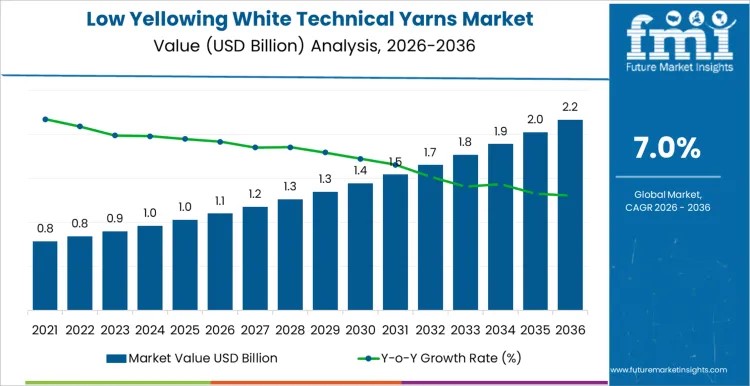
NEWARK, DE, UNITED STATES, January 21, 2026 /EINPresswire.com/ -- The global low yellowing white technical yarns market is forecast to grow from USD 1.1 billion in 2026 to USD 2.2 billion by 2036, expanding at a compound annual growth rate (CAGR) of 7.0% over the period. The outlook reflects rising demand across medical textiles, filtration media, automotive interiors, protective fabrics, and industrial technical applications, where long-term visual stability is treated as a functional and regulatory requirement rather than an aesthetic preference.
This growth trajectory is anchored in markets across China, the United States, Germany, South Korea, and Japan, where technical textile programs increasingly specify resistance to discoloration under defined heat, light, and chemical exposure conditions, based on validated program demand and specification-led procurement models.
Request For Sample Report | Customize Report |purchase Full Report - https://www.futuremarketinsights.com/reports/sample/rep-gb-31619
Market Context: Appearance Retention as a Performance Requirement
In technical textile programs, white yarns fail on perception before they fail on strength. Product acceptance in filtration fabrics, medical disposables, automotive interiors, and protective textiles increasingly depends on how well whiteness is retained after heat setting, coating, lamination, sterilization, and long-term storage.
Material screening focuses on polymer purity, stabilizer systems, and resistance to thermal aging, rather than tensile performance alone. Designers specify whiteness index targets, allowable post-aging color shift, and additive chemistry during early-stage product definition. Once a yarn grade is approved, substitution requires renewed accelerated aging tests and full appearance validation.
As a result, the low yellowing white technical yarns market has evolved into a specification-critical input category, where volume growth follows the number of regulated or appearance-sensitive textile programs rather than price-driven sourcing cycles.
Market Size and Growth Forecast Through 2036
• Market value (2026): USD 1.1 billion
• Forecast value (2036): USD 2.2 billion
• CAGR (2026–2036): 7.0%
Revenue expansion is being supported by:
• Tighter audit and certification standards
• Wider use in regulated and long-life technical products
• Thicker constructions in selected end uses
• Longer supply commitments that lock yarn grades into fixed specifications
Annual market value is expected to move into the mid-to-upper USD billions during the early 2030s, with growth driven by broader penetration into applications where visual conformity governs acceptance and shelf life.
How Procurement Models Are Shaping Market Structure
Commercial activity in the low yellowing white technical yarns market is defined by multi-year supply agreements tied to validated fabric platforms. Stock policies prioritize continuity of approved grades with proven aging behavior. Manufacturing cost structures reflect:
• Raw material screening discipline
• Line hygiene and contamination control
• Additive dosing accuracy
• Inspection and audit workloads
Converters monitor shade drift, rejection rates, and customer audit findings, rather than unit yarn pricing. Supplier changes typically occur during scheduled platform updates, not routine sourcing rounds.
Polymer Type Analysis: Polyester Sets the Reference Standard
Polyester technical yarns account for approximately 36% of global demand, making them the leading polymer family in low yellowing programs. Their dominance is attributed to:
• Stable crystallinity control
• Additive packages optimized for heat and light resistance
• Predictable aging behavior during molding and heat setting
Polyamide and high-performance yarns serve higher-temperature duties but require tighter stabilization and controlled storage. Polypropylene covers lightweight structures with narrower exposure envelopes. Blends and co-polymers address stiffness–appearance tradeoffs.
Once a polymer family is selected, draw ratios, finishing recipes, inspection limits, and training materials are all written around the same aging behavior, making later polymer substitution operationally and financially disruptive.
Application Analysis: Automotive and Transport Lead Demand
Automotive and transport textiles represent about 28% of total market demand, making them the largest application segment. Interior components face repeated thermal cycles and long in-vehicle service life, with approval files linking yarn tone directly to trim uniformity across parts and suppliers.
Other major application areas include:
• Industrial sewing threads for contrast stitching and labeling
• Protective and workwear textiles requiring laundering stability
• Filtration fabrics and industrial laminates exposed to heat and chemicals
In each case, yarn choice is governed by acceptance risk, audit exposure, and rework avoidance, rather than initial brightness alone.
Regional Outlook: China Leads Growth
CAGR by Country (2026–2036):
• China: 8.2%
• USA: 6.7%
• Germany: 6.6%
• South Korea: 6.2%
• Japan: 5.5%
China leads growth due to large-scale production of medical disposables, hygiene products, and technical nonwovens. The United States and Germany show steady expansion tied to healthcare, filtration, and protective textiles. Japan and South Korea follow specification-driven growth paths shaped by certification risk controls and program architecture standards.
Competitive Landscape and Supplier Positioning
Key companies operating in the low yellowing white technical yarns market include:
• Toray Industries
• Teijin Frontier
• Indorama Ventures
• Hyosung
• Cordenka
• Kordsa Teknik Tekstil
• UNIFI
• Ascend Performance Materials
• Kolon Industries
• Nylstar
Outlook: Specification Ownership Drives Long-Term Value
Market expansion is constrained by the discipline required to achieve low yellowing performance and by cost sensitivity in volume-driven technical textile categories. Qualification models are shifting toward locking yarn grades into long-running programs, with commercial success depending on predictability under real production conditions, not laboratory whiteness values.
As more regulated and appearance-sensitive applications adopt stricter lifetime appearance criteria, low yellowing white technical yarns are becoming risk-control materials, central to acceptance, certification, and warranty exposure management across the global technical textiles industry.
Browse Related Insights
Carbon Fiber Wraps Market https://www.futuremarketinsights.com/reports/carbon-fiber-wraps-market
Nonpackaging Foam Market https://www.futuremarketinsights.com/reports/nonpackaging-foam-market
Polyphenylsulfone Market https://www.futuremarketinsights.com/reports/polyphenylsulfone-market
About Future Market Insights (FMI)
Future Market Insights, Inc. (FMI) is an ESOMAR-certified, ISO 9001:2015 market research and consulting organization, trusted by Fortune 500 clients and global enterprises. With operations in the U.S., UK, India, and Dubai, FMI provides data-backed insights and strategic intelligence across 30+ industries and 1200 markets worldwide.
Sudip Saha
Future Market Insights Inc.
+1 347-918-3531
email us here
Legal Disclaimer:
EIN Presswire provides this news content "as is" without warranty of any kind. We do not accept any responsibility or liability for the accuracy, content, images, videos, licenses, completeness, legality, or reliability of the information contained in this article. If you have any complaints or copyright issues related to this article, kindly contact the author above.
