

Collagen Casings Market Forecast 2026–2036: Global Market to Reach USD 3,170.70 million by 2036 at 5.9% CAGR
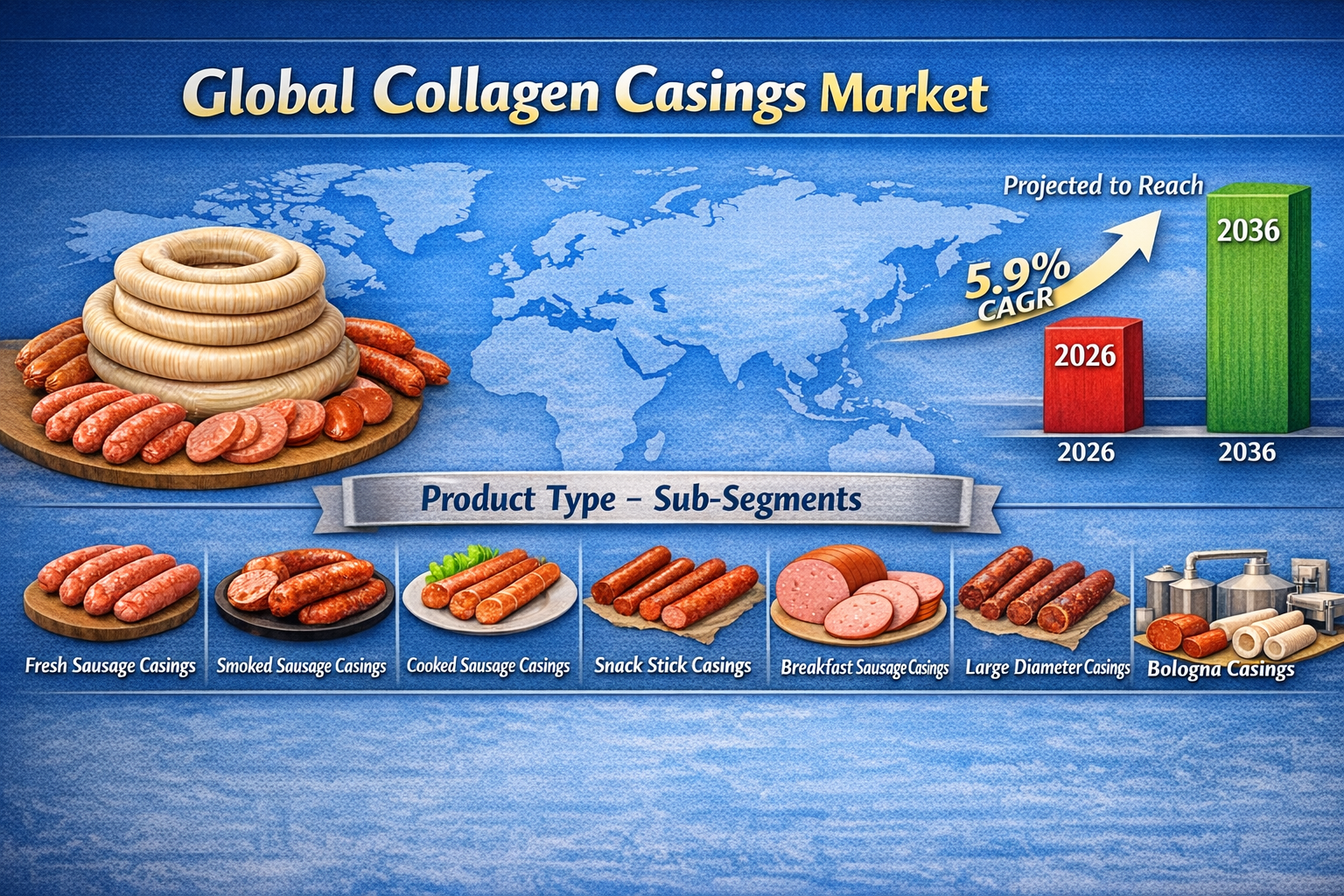
Collagen Casings Industry Size
Collagen casings gain momentum as industrial meat processors prioritize automation compatibility, extrusion precision, and contract-driven sourcing stability.
NEWARK, DE, UNITED STATES, February 20, 2026 /EINPresswire.com/ -- The global collagen casings market is projected to expand from USD 1,788.70 million in 2026 to USD 3,170.70 million by 2036, registering a CAGR of 5.9% over the forecast period. Growth is structurally tied to industrial meat processing modernization, where extrusion precision, tensile stability, and diameter uniformity directly impact stuffing-line efficiency and yield economics.
Unlike discretionary packaging components, collagen casings function as calibrated production inputs embedded within high-speed sausage manufacturing systems. Performance consistency under automated stuffing conditions—particularly burst resistance and moisture control—has become the defining value driver across global procurement frameworks.
Request For Sample Report | Customize Report | Purchase Full Report - https://www.futuremarketinsights.com/reports/sample/rep-gb-8807
Performance-Linked Demand Reshapes Market Structure
Collagen casings are increasingly preferred over natural gut alternatives in mid-tier and high-volume sausage categories. While natural gut maintains sensory advantages in premium and artisanal formats, its diameter variability and limited automation compatibility restrict use in industrial-scale lines.
Collagen casings deliver:
• Standardized caliber control
• Predictable tensile strength under mechanical stress
• Reduced rupture-related downtime
• Compatibility with automated shirring and stuffing systems
Once production lines are calibrated to collagen specifications, supplier switching costs increase due to revalidation requirements, reinforcing long-term contracts and structured procurement.
Segment Economics Reflect Industrial Priorities
Edible collagen casings account for 68.7% of total product-type share, reflecting processor preference for peel-free workflows that reduce manual handling and improve throughput continuity. Non-edible formats serve peelable and large-caliber applications requiring post-processing removal.
Diameter segmentation further underscores operational alignment:
• Medium caliber: 38.2% share
• Small caliber: 34.7% share
• Large caliber: 27.1% share
Small and medium calibers collectively dominate because they operate in high-frequency production cycles where stuffing velocity and dimensional tolerance precision are critical.
Application concentration reinforces this structure. Fresh sausages represent 27.7% of total share, followed by cooked sausages at 22.4% and smoked sausages at 16.3%. These categories require casing stability under stuffing pressure, thermal exposure, and smoke permeability conditions. Even minor performance deviations can increase scrap rates and disrupt line efficiency.
Supply Chain Discipline and Regulatory Compliance
Collagen casings rely on bovine and porcine-derived inputs, placing supply chains under strict regulatory oversight. BSE controls, specified risk material removal, veterinary certification, and traceability documentation remain essential in export-oriented markets.
Porcine collagen reduces BSE exposure but introduces halal and kosher certification requirements in select regions. Manufacturers with diversified sourcing, vertical integration into hide processing, and documented compliance frameworks demonstrate stronger resilience against livestock cycle volatility and cross-border trade restrictions.
Margins remain sensitive to raw hide pricing, influenced by slaughter cycles, feed costs, and leather industry demand. Producers mitigate exposure through long-term procurement contracts, geographic sourcing diversification, and conversion efficiency optimization.
As noted by Rutger Helbing, Chief Executive Officer of Devro plc, in the company’s 2021 Annual Report:
“The Group has also increased investment in new product development with a particular focus on alternative technologies and the use of collagen in different applications.”
This reflects the broader industry focus on extrusion advancement and application expansion within standardized processing environments.
Country-Level Expansion Reflects Industrial Capacity
China holds the largest country share at 20.3% in 2026 and is projected to grow at 6.7% CAGR through 2036. Leadership is supported by domestic sausage production scale and established collagen extrusion infrastructure aligned with high-volume medium and small caliber formats.
The United States accounts for 16.7% share and is expected to expand at 5.4% CAGR, driven by technologically advanced stuffing systems and contract-oriented procurement structures emphasizing burst resistance and diameter stability.
India emerges as the fastest-growing market at 7.5% CAGR, reflecting rapid modernization of organized meat processing facilities and growing adoption of automation-compatible edible casings.
Germany (4.6%), the United Kingdom (4.3%), and Japan (3.9%) demonstrate steady expansion supported by mature processing infrastructure and strong compliance documentation requirements.
Competitive Landscape Driven by Extrusion Precision
The competitive environment is moderately concentrated at the top tier.
• Viscofan Group leads with 9.2% share
• Devro holds 8.1%
• Shenguan Holdings accounts for 7.1%
Remaining market share is distributed across regional and mid-sized extrusion operators.
Strategic focus areas include high-speed extrusion lines, multilayer casing engineering, automated shirring systems, and vertical integration into collagen sourcing. Performance uniformity under mechanical stress—rather than branding—remains the decisive differentiator.
Recent strategic activity includes acquisition-driven sourcing expansion in South America and production optimization initiatives in China aimed at improving collagen extraction efficiency and casing output stability.
Structural Outlook Through 2036
Future growth will remain anchored in automation alignment, contract-based procurement, and extrusion engineering discipline. As global meat processors prioritize yield predictability and uptime optimization, collagen casings will continue to function as performance-calibrated industrial inputs rather than discretionary packaging components.
Market expansion through 2036 is therefore expected to reflect structured capacity scaling, supply-chain traceability integration, and measurable performance reliability within automated stuffing ecosystems.
Why FMI: https://www.futuremarketinsights.com/why-fmi
Browse Related Insights
Collagen Casings Market Share Analysis: https://www.futuremarketinsights.com/reports/collagen-casings-market-share-analysis
UK Collagen Casings Market: https://www.futuremarketinsights.com/reports/united-kingdom-collagen-casings-market
Europe Collagen Casings Market: https://www.futuremarketinsights.com/reports/europe-collagen-casings-market
About Future Market Insights (FMI)
Future Market Insights, Inc. (FMI) is an ESOMAR-certified, ISO 9001:2015 market research and consulting organization, trusted by Fortune 500 clients and global enterprises. With operations in the U.S., UK, India, and Dubai, FMI provides data-backed insights and strategic intelligence across 30+ industries and 1200 markets worldwide.
Sudip Saha
Future Market Insights Inc.
+ +1 347-918-3531
email us here
Legal Disclaimer:
EIN Presswire provides this news content "as is" without warranty of any kind. We do not accept any responsibility or liability for the accuracy, content, images, videos, licenses, completeness, legality, or reliability of the information contained in this article. If you have any complaints or copyright issues related to this article, kindly contact the author above.
