

AI as the New Proxy Advisor: Reshaping Shareholder Activism Communications
Executive Summary
Kekst CNC analyzed contested annual meeting elections from 2023 to 2025, roughly since the universal proxy card was instituted – to understand AI’s recommendations if it acted as a traditional proxy advisor.
This analysis highlights crucial conclusions affecting the intersection of AI and activism communications:
| What biases do major LLMs exhibit when asked to provide voting recommendations in proxy fights? | What arguments most influence AI voting recommendations? | Which sources most often shape AI analysis in proxy fights? |
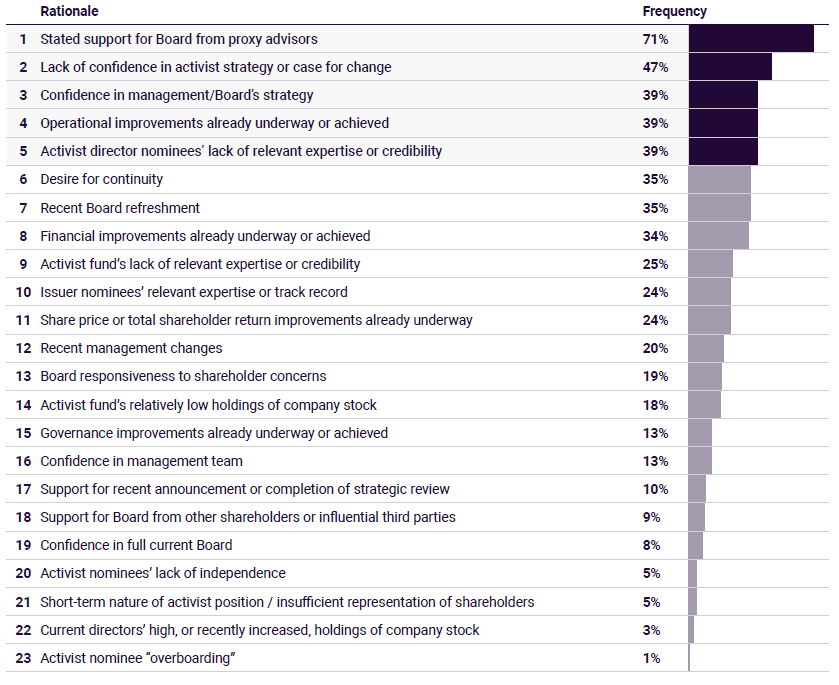
| AI is currently more likely to support an activist’s case for change than an incumbent Board and management team. This would tilt the playing field towards activists, relative to the historical rate of pro-management recommendations from ISS and Glass Lewis. | Articulating a clear strategic vision and execution plan is more important than ever to address AI’s ingrained tendencies. The key factors influencing AI recommendations are confidence in the company’s strategy, management team, and operational enhancements underway. |
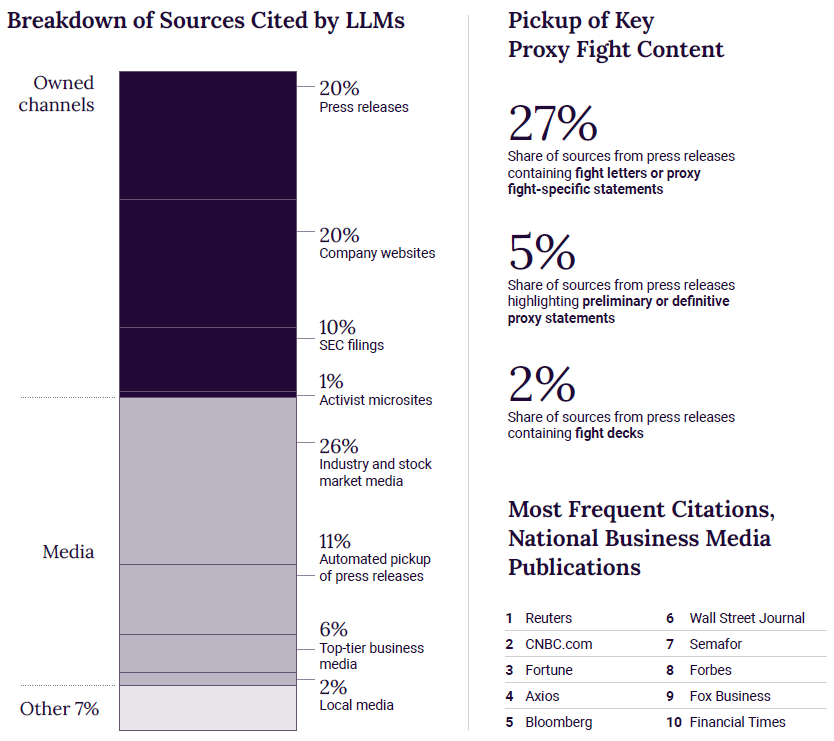
In line with AI’s general sourcing biases, owned content – especially press releases – are vital inputs. While top-tier media remain influential, LLMs frequently source lower-quality, but higher-volume, automated sites for retail financial analysis. |
Context
For proxy fights – often companies’ most influential inflection points – AI is becoming more than a passive information source. It is emerging as a powerful tool for recommending votes to investors.
The implications have the potential to reshape traditional activism communications playbooks. AI may challenge established arguments used by both activists and targets, elevate narratives that resonate with large language models (LLMs), and reward tactics optimized for model consumption.
Issuers and activists will increasingly need to treat AI with the same intentionality applied to legacy proxy advisors: presenting ingrained tendencies that can sway outcomes, and requiring active human
judgment and input to influence.
Boards and management teams must adapt shareholder engagement strategies for a world in which investors – from large asset managers to retail shareholders – not only use generative AI for information, but also for proxy voting decisions themselves.
Just as advanced AI, large language models (LLMs), and autonomous agents are reshaping nearly every industry, shareholder activism is likely to experience its own disruption. The most potent example to date came in January 2026, when J.P. Morgan discontinued its subscriptions to proxy advisory services and began using a proprietary AI engine to guide its voting decisions.
Traditional activism communications norms are evolving through information consumption habits and changing tactics. Regulatory changes and growing pressure on proxy advisors to address perceived bias are altering the landscape. AI may accelerate these shifts.
Whether shareholder activism experiences an AI-enabled revolution or gradual evolution remains uncertain. What is clear is that companies, activists, and their advisors must quickly understand the potential ramifications of AI for proxy fights and thoughtfully adapt their communications strategies accordingly.
The implications for voting outcomes and proxy fights could be significant: reliance on AI to digest proxy and other information to inform a vote is not only a potential “democratizing” force for retail investors, but also a legitimate tool for financial institutions of all sizes.
- Some proxy fights are meaningfully influenced by retail participation. In some cases, retail voting is necessary simply to reach quorums. As individual investors increasingly rely on chatbots for financial and market information, AI could influence both their voting preference and their willingness to participate. Retail investors are traditionally assumed to favor management; that dynamic may be amplified if retail becomes more active in proxy voting.
- Most small and midsize institutions are unlikely to have the resources to build a bespoke AI voting engine like J.P. Morgan’s. For those that seek support from AI, many will instead rely on widely available LLM chatbots and AI search tools, effectively creating a commonly shared alternative to traditional proxy advisors.
- Even when large index funds and active institutions develop bespoke proxy voting engines, those tools will likely rely on major underlying LLM architectures. Understanding how these models process proxy information may therefore offer insight into future institutional voting behavior.
AI’s “Proxy Advisor” Recommendations
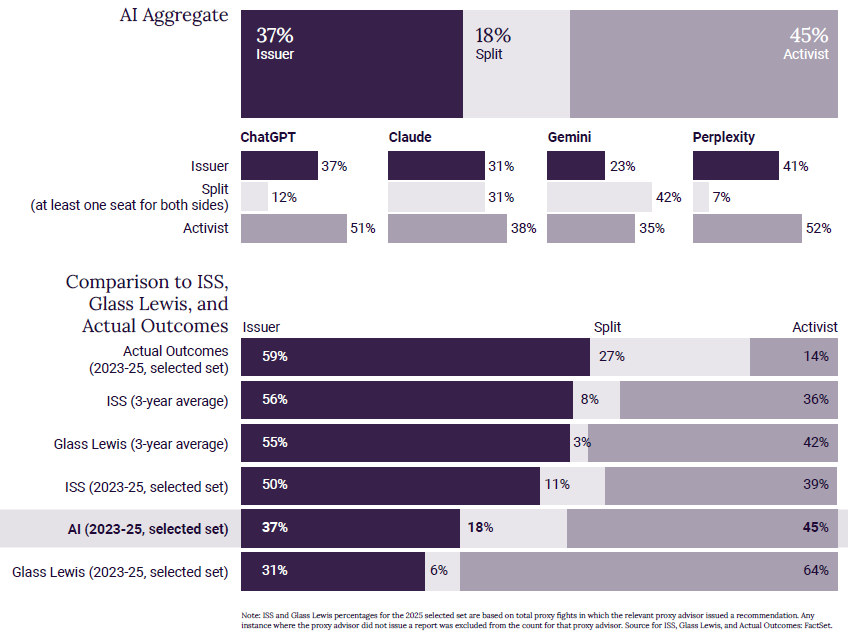
AI is meaningfully more likely to articulate support for activists than traditional proxy advisors – as well as real proxy contest outcomes
Communications Takeaways
1. AI has the potential to meaningfully bias shareholders towards full or partial support of dissident slates in proxy fights – with a substantial delta from the historical recommendations of ISS and Glass Lewis.
Activists won at least one board seat in 41% of the selected proxy contests. Yet each of the four LLMs in the analysis would have recommended the activist’s slate, or a split card (a partial activist victory), well more than half the time – as much as 77% in the case of Gemini.
AI on average demonstrated just 37% support for issuers. This represents substantially lower management support than ISS (56%) and Glass Lewis (55%) have recorded in proxy fights since the inception of UPC; and well below the 59% management winning rate in the actual proxy contests.
2. In the absence of tested stewardship frameworks used by the proxy advisors and many institutions, the AI engines are far from homogeneous in their analyses – and biases. Companies and activists should increasingly view each LLM as independent “proxy advisors,” with content and tactics refined for generative engine optimization (GEO).
Issuers and dissidents may find greater traction on certain platforms compared to others: Perplexity is the most company-friendly, with 41% support, while Gemini is the least at 23%. The rationales and depth of analysis also meaningfully vary. For example, Claude frequently values the relevant experience of dissident director nominees and the track record of the activists. Gemini is more likely to appreciate management’s desire to avoid disruption at critical moments – or call out when independent shareholder accountability is needed to force change.
Strategists in the proxy arena should keep in mind that no two AI searches are exactly alike. Our analysis conducted identical queries over multiple time periods and locations – with the outputs demonstrating meaningful variance in the sourcing, rationales, and often even the final recommendation. Across the analyzed contests, votes within a single LLM changed at least once in 38% of them.
This variability in the application of bias underscores the criticality of human judgment in the process. An experienced lens for which messages meet a high standard for impact, and which do not pass the smell test, is necessary to maximize the potential influence on probabilistic AI algorithms.
3. ISS’s and Glass Lewis’s recommendations were the AI engines’ most frequently
cited reason for supporting one side or the other in a contested situation.
The approach of treating AI as proxy advisors should not downplay the critical role of the traditional proxy advisors, which remain broadly used among institutions. The LLMs themselves certainly do not underestimate the value of ISS and Glass Lewis: well more than half of all chatbot responses noted their outcomes as a dispositive factor. All sides in a contest should prioritize highlighting favorable recommendations and supporting language from the proxy advisors, through press releases and any other channels that could be influential in LLM analysis.
4. Importantly for communications narratives, while consistent threads exist in how LLMs rationalize pro-activist or pro-management votes, it is difficult to define obvious “worldviews” through which a single engine decides to select one side or the other.
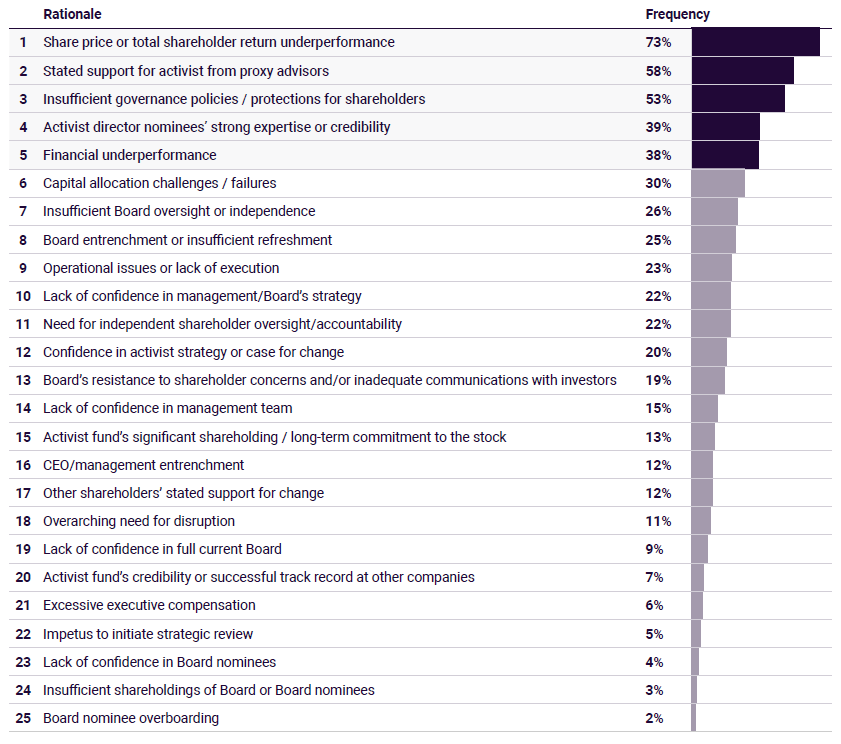
Unsurprisingly, AI votes for activists most often make note of underperforming share price or total shareholder return. Inadequate governance policies and insufficient protections for shareholders are another frequent rationale. On the pro-management side, the majority of recommendations either articulate confidence in the company’s existing strategy or plan, or state that the activist’s strategy is unclear or a strong case for change has not been established.
More challenging is to identify clear lenses for each LLM whereby certain categories of factors (strategic, operational, governance, nominees) are most valuable to their analysis. Many of the most impactful arguments affecting recommendations across the board center on strategy and operational execution.
Understanding how LLMs distill inputs into recommendations requires a mindset shift from the traditional proxy advisor approach, with each following highly defined frameworks and standards against which data is collected and hypotheses are tested. The algorithms that underpin AI are themselves frameworks – but with a black box of inputs and inconsistent outputs. In that light, historical outcome data is important and instructive, though not dispositive.
5. Some of the most common rationales used by both sides in proxy fights do not hold the same cachet among the AI engines.
Perhaps most notably for issuers, two traditionally core arguments have only relatively moderate influence for AI, each seeing around 25% frequency in pro-management votes:
- Lack of credibility or experience attributed to the activist fund itself (separate from its nominees). It is particularly worth highlighting that in very few cases did AI cite procedural or tactical accusations against activists – such as suspicious timing of actions taken, trading activity/disclosures, or track record of unconstructive engagement with the board.
- Expertise and track record of the board’s nominees. The vast majority of the time, AI did not attempt to compare the two sides’ nominees. In cases where director nominee quality was a factor, the rationale was either rounding out skills central to the company’s strategy, or a desire to avoid disruption of the board’s oversight of ongoing progress.
In addition, certain arguments frequently relied upon by issuers to question the motives of activists hold minimal weight among the LLMs. The short-term nature of an activist’s position, or the activist not representing the true interests of shareholders, was mentioned in just 5% of pro-management votes. On the activist side, relatively lower-priority arguments included:
- Specific critiques of the management team. While CEO targeting by activists has broadly increased in recent proxy cycles, AI rarely attributes underperformance directly to CEOs – and in no instance did an engine explicitly call for replacement. Lack of confidence in management was mentioned 15% of the time; CEO/management entrenchment just 12%.
- An imperative to initiate a strategic review, excessive executive compensation, and insufficient stock holdings by directors and officers all rated as some of the least frequently cited rationales by AI.
6. The single most important channel to articulate arguments that affect AI recommendations is the press release. Companies and activists alike must continue to prioritize releases as an essential weapon in the GEO arsenal.
While the influence of the legacy press release has moderately waned in recent years through the creation of direct-to-stakeholder channels, AI has breathed powerful new life into it – a trend that is borne out in the context of proxy fight searches. Releases represented nearly one-third of all citations informing AI responses – whether through direct links to the newswires through which they were issued, or through full reprints on automated websites.
Notably, the analysis did not uncover obvious volume “fatigue” among engines, i.e., consuming a maximum number of press releases to inform its recommendations. The breadth of attribution was typically a function of the depth of the engine’s analysis – Gemini’s analyses are more detailed, for example, while Perplexity’s are shallower. Sourcing can also change meaningfully when running the same search multiple times or by different users. A valuable subject for further study and testing is whether companies and activists should consider increasing their rate of press release issuance in contested situations to “flood the zone” with content deemed most credible by AI engines.
7. Another traditional tactic, the “fight deck,” has a much more negligible influence on AI recommendations. While today its public presentation often stands as a core milestone in the traditional timeline ahead of shareholder votes, in its current form (which often requires meaningful resources to produce) it may become a less potent tool in an AI-forward proxy environment.
Fight decks – presentations that can sometimes contain many dozens of slides, typically released ahead of and used in meetings with ISS and Glass Lewis – are almost never cited directly by AI engines. Press releases that announce the publishing of fight decks and condense core arguments do have a role to play; these comprise about 2% of sources.
The upshot is that, to the extent AI is an increasingly relied-upon tool for proxy voting, communications which attempt to win every large and small argument will likely become increasingly inefficient. AI chatbots are designed to distill complex and high-volume information for users. Companies and activists should strive to do the same if they want AI to intake, and advocate with, the highest-value assertions.
8. Major business publications are essential formats for storytelling to the investment community – but less so to AI. Participants need to pay close attention to all forms of online website distribution to maximize impact.
Top-tier financial publications with dedicated activism beat reporters remain influential with key stakeholders. But our analysis – in line with broader research on media’s influence on AI – underscores that a flood of digital content exists in the public domain that both dwarfs volume of “sophisticated” media, and continues to hold meaningful credibility by LLMs. As a result, top-tier media comprised just 6% of sources informing AI proxy recommendations.
Broader online content is very frequently automated, spanning retail stock-picking and financial news websites that either syndicate or condense, to varying degrees, press releases and regulatory filings. AI engines treat these sources almost as extensions of owned content – with the veneer of third-party media credibility, but without the discernment of site quality or human contributions. Participants in proxy contests should take stock of the entire content landscape and evaluate all of the directions through which AI can become sensitized to corporate communications.
It is also worth noting what generally did not pass muster for the AI engines: broadcast interviews or commentary, podcasts, social media, and digital advertising. Microsites dedicated to proxy fights also saw relatively limited pickup – but this may be attributable to such sites generally being shut down and taken offline after contests concluded, thereby becoming inaccessible for this retrospective analysis.
How AI Leverages Information Sources
Factors Influencing AI Recommendations for Issuers
Takeaways from LLMs’ Recommendations for Issuers
ChatGPT
- Proxy advisor support and activists’ insufficient cases for change represented the clear top two factors for ChatGPT, each appearing in more than two-thirds of recommendations.
- Support for the company’s strategy and an appreciation for continuity rated particularly highly in ChatGPT’s responses compared to others.
- Board-level actions – including refreshment, leadership succession, governance improvements, and responsiveness to shareholders – had limited impact, each recording less than 20% frequency.
Claude
- Management support from ISS and/or Glass Lewis was cited in nearly every response as a key factor in Claude’s recommendations.
- The lower quality of activists’ director nominees played a significant role in support for management, factoring into more than half of recommendations, outpacing the other LLMs.
- Conversely, a dissident’s insufficient case for change was far less of a factor for Claude than others, appearing about a quarter of the time.
Gemini
- Gemini demonstrated the most vocal support for avoiding disruption in management – and Board-led turnarounds – appearing in almost two-thirds of arguments.
- Case for change played an important role, as nearly 60% of recommendations argued the activist had not sufficiently articulated an alternative strategy, and a similar rate highlighted operational improvements already underway by the company.
- Qualifications of specific nominees were relatively deprioritized: approximately one-quarter stated support for Board nominees, and a similar amount suggested dissident nominees lacked sufficient expertise.
Perplexity
- Perplexity’s recommendations generated the most dispersion in rationale frequency, with most
arguments showing up less than a third of the time. The exception was insufficient dissident case for change, at 57%. - Its responses were least likely to cite ongoing progress or actions as key factors.
- In general, Perplexity’s recommendations were the least detailed of the LLMs, with relatively short responses and notably high-level arguments.
Factors Influencing AI Recommendations for Activists
Takeaways from LLMs’ Recommendations for Activists
ChatGPT
- ChatGPT’s pro-activist recommendations primarily fixated on the top three rationales in the above table: stock price or TSR weakness, proxy advisor support, and governance issues.
- Compared to the other engines, ChatGPT was relatively unlikely to attribute the need for change to specific operational, financial, or strategic concerns.
- However, it was more frequent in highlighting issues with Board entrenchment or insufficient oversight or independence.
Claude
- Similar to its recommendations in support of management – though not as universal – Claude’s
most common pro-dissident rationale was the support of ISS and/or Glass Lewis. - While overall governance protections for shareholders were a frequent critique, Board entrenchment and oversight were not, relative to the other LLMs – appearing around 20% of the time.
- Claude was also relatively more attentive to positive arguments about the activist itself – including demonstrating shareholder alignment through substantial stakes, track record driving value creation at other companies, and the credibility of its nominees.
Gemini
- Share price underperformance was cited in nearly all of Gemini’s recommendations for activists.
- Specific actions driving underperformance were high priorities for Gemini, including capital
allocation, weak financial results or missed guidance, and lack of operational execution. It was
the most likely of the engines to imply a lack of confidence in management’s strategy. - Gemini was also the most likely to highlight a need for independent shareholder oversight – and to praise the credibility of dissident nominees to provide that accountability.
Perplexity
- Matching its pro-management recommendations, Perplexity’s arguments for activists were both highly dispersed and limited in detail relative to the other LLMs.
- Share price performance rated low in Perplexity’s arguments. It was relatively more likely to point out specific financial, operational, and strategic issues under management’s watch.
- Perplexity was the most vocal of the engines in articulating an overarching need for disruption to turn around company performance.
The complete publication is available here.
Legal Disclaimer:
EIN Presswire provides this news content "as is" without warranty of any kind. We do not accept any responsibility or liability for the accuracy, content, images, videos, licenses, completeness, legality, or reliability of the information contained in this article. If you have any complaints or copyright issues related to this article, kindly contact the author above.
