

Demand Response Management System Market Share Estimated To Grow at a CAGR of 12.8%, To Reach USD 3.49 Billion By 2035
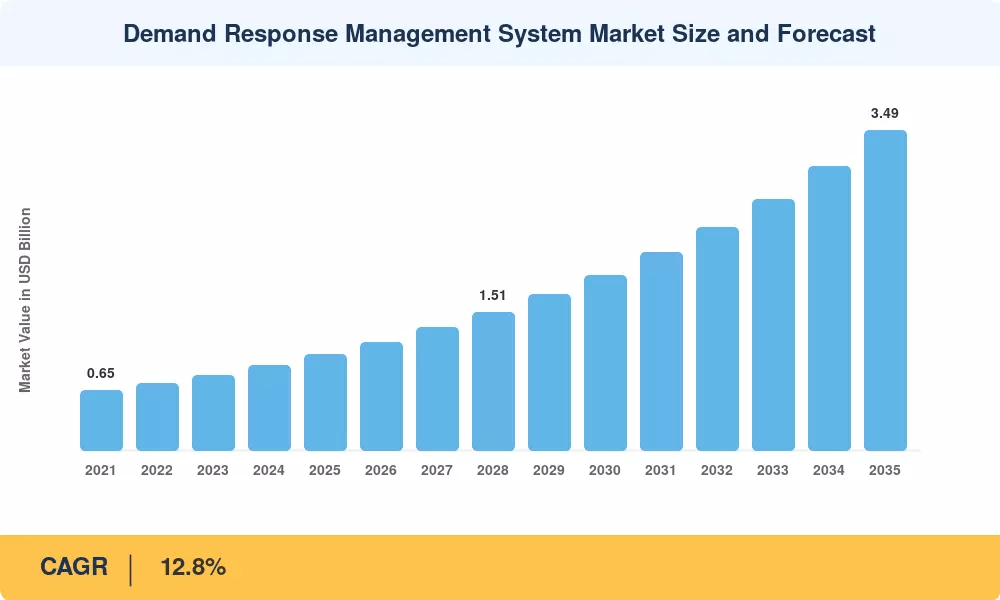
Demand Response Management System Market Summary
Residential applications are expanding at a CAGR of 14.9%, accelerated by connected-thermostat penetration exceeding 55 million units in North America alone.
Software platforms account for roughly 52% of the Demand Response Management Market, reflecting utilities' preference for scalable cloud-native orchestration layers over hardware-centric deployments.”
NY, CA, UNITED STATES, July 9, 2026 /EINPresswire.com/ -- The Demand Response Management System Market is positioned for strong long-term growth as utilities and energy providers accelerate investments in smart grids, renewable energy integration, and intelligent demand-side management. Rising electricity demand, expanding distributed energy resources, supportive government regulations, and increasing consumer participation are creating substantial opportunities across global markets.— Arti Dhapte
The Demand Response Management System (DRMS) Market Share is witnessing robust growth as utilities, grid operators, and energy providers increasingly adopt intelligent demand-side management solutions to improve grid reliability, optimize electricity consumption, and support renewable energy integration. According to Market Research Future analysis, the Demand Response Management System Market reached an estimated USD 1.05 billion in 2025 and is projected to grow from USD 1.18 billion in 2026 to USD 3.49 billion by 2035, registering a CAGR of 12.8% during the forecast period (2026–2035). Market expansion is being driven by smart grid modernization, rising electricity demand, increasing renewable energy penetration, favorable government policies, and growing investments in digital energy infrastructure.
Demand Response Management Systems enable utilities and consumers to balance electricity supply and demand by encouraging temporary reductions or shifts in electricity consumption during peak demand periods. These systems leverage advanced communication technologies, automation, smart meters, and analytics to optimize energy usage while improving grid stability and reducing operational costs.
Demand Response Management System (DRMS) Market Overview
The Demand Response Management System Market has become an essential part of modern energy management as power grids become more complex with increasing distributed energy resources and renewable energy generation. Utilities are deploying DRMS platforms to improve demand forecasting, reduce peak load, enhance customer engagement, and avoid costly investments in additional generation capacity.
Growing electricity consumption from industrial facilities, commercial buildings, electric vehicles, and residential users is increasing the need for flexible demand-side energy management solutions. Demand response programs help utilities maintain reliable electricity supply while enabling consumers to reduce energy bills through incentive-based participation.
The increasing adoption of smart grids and digital utility infrastructure is further accelerating the implementation of advanced demand response management technologies across developed and emerging economies.
Get Free Sample PDF Brochure:
https://www.marketresearchfuture.com/sample_request/6694
Demand Response Management System (DRMS) Market Segmentation
The Demand Response Management System Market can be segmented based on component, solution type, application, and end user.
By Component
Software
Hardware
Services
By Solution Type
Residential Demand Response
Commercial Demand Response
Industrial Demand Response
By Application
Peak Load Management
Energy Cost Optimization
Grid Reliability
Renewable Energy Integration
Emergency Demand Response
Ancillary Grid Services
By End User
Utilities
Residential Consumers
Commercial Buildings
Industrial Facilities
Government Organizations
Data Centers
Healthcare Facilities
Educational Institutions
Market Drivers
One of the primary drivers of the Demand Response Management System Market is the rapid deployment of smart grid infrastructure. Utilities are investing heavily in digital grid technologies that improve communication between power suppliers and consumers, enabling real-time demand response capabilities.
The growing integration of renewable energy sources such as solar and wind is another major growth driver. Since renewable generation is inherently variable, demand response programs help balance electricity supply and demand, improving overall grid flexibility and reliability.
Increasing electricity demand across residential, commercial, and industrial sectors is encouraging utilities to implement demand response solutions that reduce peak load and optimize energy distribution without constructing new power plants.
Government regulations promoting energy efficiency and carbon emission reduction are also supporting market expansion. Many countries provide financial incentives, regulatory support, and utility mandates for implementing demand response programs.
The rapid growth of electric vehicles is creating additional demand for intelligent load management systems capable of coordinating EV charging while minimizing grid congestion.
Emerging Market Trends
Several important trends are shaping the Demand Response Management System Market. One of the most significant is the increasing adoption of cloud-based DRMS platforms that provide scalable, flexible, and remotely accessible energy management capabilities.
Artificial intelligence and machine learning are becoming integral components of demand response solutions, enabling more accurate demand forecasting, automated load control, and predictive energy optimization.
Another notable trend is the expansion of virtual power plants (VPPs), where distributed energy resources such as rooftop solar systems, battery storage, and flexible loads are aggregated and managed through advanced demand response platforms.
Consumer participation is increasing through mobile applications and smart home technologies that provide real-time energy consumption data and automated demand response capabilities.
Utilities are also integrating battery energy storage systems with demand response programs to improve grid resilience, maximize renewable energy utilization, and reduce electricity costs during peak demand periods.
Buy Now Premium Research Report:
https://www.marketresearchfuture.com/checkout?currency=one_user-USD&report_id=6694
Technology Advancement Driving Market Growth
Technological innovation is transforming the Demand Response Management System Market by improving automation, intelligence, and operational efficiency. Advanced artificial intelligence algorithms analyze historical consumption patterns, weather conditions, and grid behavior to optimize demand response strategies in real time.
Internet of Things (IoT) devices, including smart thermostats, connected appliances, intelligent meters, and industrial sensors, enable automated load control while improving customer participation in demand response programs.
Advanced Metering Infrastructure (AMI) provides utilities with high-resolution energy consumption data, supporting dynamic pricing models, real-time billing, and improved grid management.
Edge computing technologies enable faster decision-making by processing demand response data closer to connected devices, reducing communication delays and enhancing system responsiveness.
Cybersecurity solutions have become increasingly important as digital grid infrastructure expands. Modern DRMS platforms incorporate secure communication protocols, encryption, identity management, and continuous threat monitoring to protect critical utility operations.
Integration with Energy Management Systems (EMS), Distributed Energy Resource Management Systems (DERMS), Supervisory Control and Data Acquisition (SCADA), and Building Management Systems (BMS) is enabling comprehensive energy optimization across utilities and commercial facilities.
Regional Insights
North America holds a significant share of the Demand Response Management System Market due to widespread smart grid deployment, advanced utility infrastructure, and supportive regulatory frameworks. The United States leads the region with well-established demand response programs, advanced metering infrastructure, and increasing renewable energy integration.
Europe remains a major market driven by ambitious decarbonization goals, energy efficiency initiatives, and expanding renewable energy capacity. Countries such as Germany, France, the United Kingdom, Italy, and the Netherlands continue investing in intelligent demand-side management technologies to improve grid flexibility.
Asia-Pacific is expected to witness the fastest market growth during the forecast period. Rapid urbanization, expanding electricity demand, smart city development, and increasing investments in digital grid infrastructure are driving adoption across China, India, Japan, South Korea, and Southeast Asia.
Latin America is gradually adopting demand response technologies as utilities modernize electricity networks and improve energy efficiency.
The Middle East & Africa are experiencing increasing deployment of smart grid technologies, renewable energy projects, and advanced utility management systems, creating new opportunities for demand response management solutions.
Browse In-depth Market Research Report:
https://www.marketresearchfuture.com/reports/demand-response-management-system-market-6694
Major Key Players
The Demand Response Management System Market is highly competitive, with leading technology providers focusing on digital innovation, smart grid software, cloud platforms, and strategic partnerships.
Some of the major market participants include:
Schneider Electric SE
Siemens AG
ABB Ltd.
General Electric (GE Vernova)
Honeywell International Inc.
Eaton Corporation plc
Oracle Corporation
IBM Corporation
AutoGrid Systems Inc.
Itron Inc.
Landis+Gyr AG
Johnson Controls International plc
Enel X
EnergyHub Inc.
Mitsubishi Electric Corporation
Technological advancements in artificial intelligence, IoT, cloud computing, advanced metering infrastructure, battery storage integration, and cybersecurity are transforming demand response capabilities while improving grid reliability and operational efficiency. As electricity networks continue evolving toward more decentralized and sustainable energy systems, Demand Response Management Systems will play a critical role in ensuring reliable, efficient, and resilient power delivery throughout the forecast period.
More Related Reports from MRFR Library:
Transformer Market https://www.marketresearchfuture.com/reports/transformer-market-5982
Recloser Market https://www.marketresearchfuture.com/reports/recloser-market-6022
HVDC Transmission Market https://www.marketresearchfuture.com/reports/hvdc-transmission-market-6027
FSRU Market https://www.marketresearchfuture.com/reports/fsru-market-6158
Virtual Pipelines Market https://www.marketresearchfuture.com/reports/virtual-pipelines-market-6178
Industrial Gases Market https://www.marketresearchfuture.com/reports/industrial-gases-market-6508
Wind Turbine Gearbox Market https://www.marketresearchfuture.com/reports/wind-turbine-gearbox-market-6616
Uninterruptible Power Supply Market https://www.marketresearchfuture.com/reports/uninterruptible-power-supply-ups-market-6623
Solar Panel Recycling Market https://www.marketresearchfuture.com/reports/solar-panel-recycling-market-6701
Oilfield Services Market https://www.marketresearchfuture.com/reports/oilfield-services-market-6835
Larry Wilson
WantStats Research And Media Pvt. Ltd.
+1 855-661-4441
email us here
Visit us on social media:
LinkedIn
Facebook
YouTube
X
Legal Disclaimer:
EIN Presswire provides this news content "as is" without warranty of any kind. We do not accept any responsibility or liability for the accuracy, content, images, videos, licenses, completeness, legality, or reliability of the information contained in this article. If you have any complaints or copyright issues related to this article, kindly contact the author above.
