

Next Generation IV Infusion Pumps Market to Reach US$ 6.3 Billion by 2033 at 8.2% CAGR | Persistence Market Research
Next Generation IV Infusion Pumps Market
BRENFORD, LONDON, UNITED KINGDOM, July 14, 2026 /EINPresswire.com/ -- The global Next Generation IV Infusion Pumps Market is evolving rapidly as healthcare providers increasingly prioritize precision drug delivery, patient safety, and connected medical technologies. Modern infusion pumps are equipped with intelligent software, wireless communication capabilities, dose error reduction systems, and real-time monitoring features that significantly improve clinical outcomes. These advanced systems help healthcare professionals administer medications with greater accuracy while minimizing the risk of human error. As hospitals and healthcare facilities continue embracing digital transformation, demand for technologically advanced infusion devices is expected to rise steadily. Growing emphasis on improving workflow efficiency, enhancing patient care quality, and reducing medication-related complications is encouraging widespread adoption of next generation IV infusion pumps across healthcare settings.
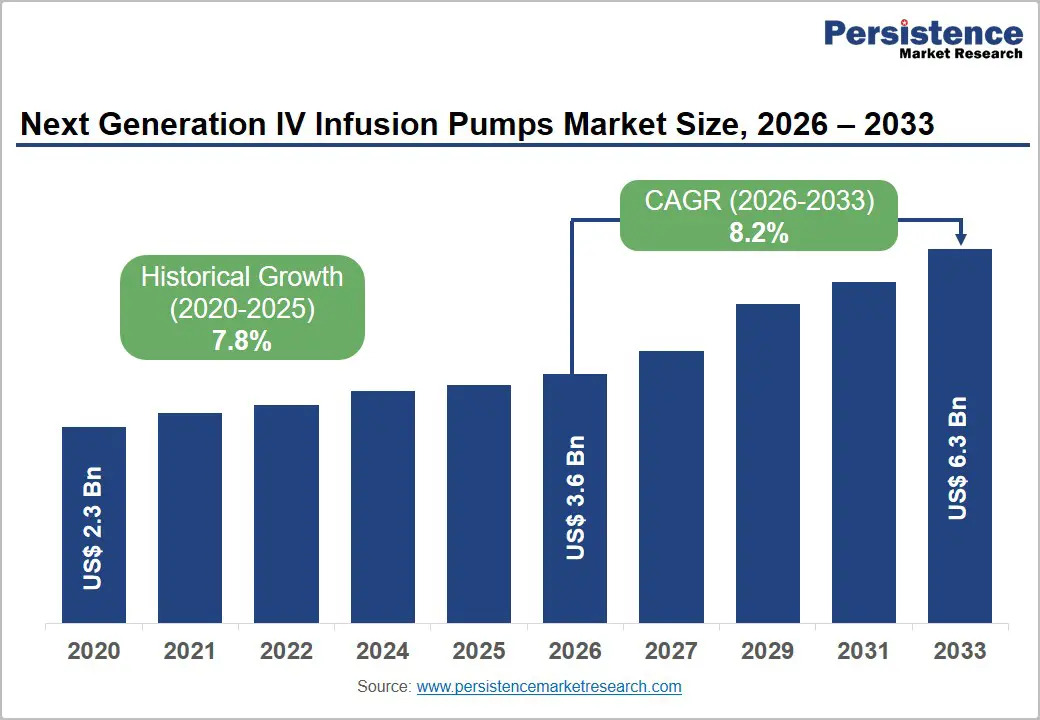
According to Persistence Market Research, the global Next Generation IV Infusion Pumps Market is expected to be valued at US$ 3.6 billion in 2026 and is projected to reach US$ 6.3 billion by 2033, expanding at a CAGR of 8.2% during the forecast period from 2026 to 2033. The market is benefiting from increasing demand for smart medical devices, rising prevalence of chronic diseases requiring continuous infusion therapy, and expanding investments in healthcare infrastructure. Smart infusion pumps represent the leading product segment because of their advanced safety mechanisms, automated drug libraries, and connectivity features. Hospitals continue to account for the largest share owing to their extensive utilization of infusion therapies across intensive care, oncology, surgery, and emergency care. North America remains the leading regional market due to advanced healthcare infrastructure, strong technology adoption, and favorable regulatory support.
Want Market Insights? Get Your Free Report Sample : https://www.persistencemarketresearch.com/samples/15781
Key Highlights from the Report
➤ The global Next Generation IV Infusion Pumps Market is projected to grow from US$ 3.6 billion in 2026 to US$ 6.3 billion by 2033, registering a CAGR of 8.2%.
➤ Smart infusion pumps continue to dominate product demand because of their enhanced medication safety and automation capabilities.
➤ Hospitals remain the leading end-user segment due to increasing patient admissions and growing infusion therapy procedures.
➤ Rising adoption of wireless connectivity and integrated software is improving healthcare workflow efficiency worldwide.
➤ Growing preference for home healthcare and outpatient treatment is expanding market opportunities for portable infusion systems.
➤ Continuous investments in digital healthcare technologies are accelerating innovation and long-term market growth.
Market Segmentation
The Next Generation IV Infusion Pumps Market is segmented by product type, application, technology, and end user. Based on product type, smart infusion pumps account for the largest market share due to their ability to improve medication accuracy through integrated safety software and automated programming. Volumetric infusion pumps, syringe infusion pumps, ambulatory infusion pumps, and specialty infusion pumps continue to play significant roles across various clinical applications. Continuous technological innovation has encouraged healthcare providers to replace conventional infusion systems with advanced smart devices capable of reducing medication errors while improving patient outcomes. Increasing demand for digital healthcare solutions is expected to further strengthen adoption across both developed and emerging healthcare markets.
Regional Insights
North America holds the largest share of the Next Generation IV Infusion Pumps Market, supported by advanced healthcare infrastructure, strong investments in digital health technologies, and widespread adoption of smart medical devices. Healthcare providers across the region continue replacing conventional infusion systems with intelligent platforms that improve medication safety and operational efficiency. Favorable reimbursement frameworks, increasing awareness regarding patient safety initiatives, and continuous product innovation further contribute to regional market leadership. The presence of major medical device manufacturers also supports ongoing research and commercialization of technologically advanced infusion solutions.
Asia Pacific is expected to witness substantial growth throughout the forecast period as healthcare infrastructure continues improving across emerging economies. Increasing healthcare expenditure, expanding hospital networks, growing awareness of advanced medical technologies, and rising patient populations are driving demand for next generation infusion pumps. Governments and private healthcare organizations are investing significantly in digital healthcare transformation, creating favorable opportunities for manufacturers. The increasing availability of modern healthcare services and greater adoption of connected medical devices are expected to support sustained regional expansion over the coming years.
Customize This Report for Your Exact Requirements : https://www.persistencemarketresearch.com/request-customization/15781
Market Drivers
The increasing focus on patient safety represents one of the strongest drivers for the Next Generation IV Infusion Pumps Market. Medication errors remain a significant concern across healthcare systems, making advanced infusion technologies an essential investment for hospitals and healthcare providers. Smart infusion pumps equipped with dose error reduction systems, programmable drug libraries, automated alerts, and wireless communication capabilities help clinicians administer medications more accurately while minimizing treatment risks. These technologies improve patient outcomes and enhance overall healthcare quality by reducing preventable infusion-related complications.
Unlock Complete Insights – Buy the Full Report : https://www.persistencemarketresearch.com/checkout/15781
Market Restraints
Despite promising growth prospects, several factors continue to limit wider adoption of next generation infusion technologies. High acquisition costs remain a significant challenge for healthcare facilities operating under budget constraints. Advanced infusion pumps require substantial investments not only for procurement but also for installation, software integration, maintenance, cybersecurity, and regular upgrades. Smaller hospitals and healthcare centers may postpone technology replacement due to financial limitations, slowing market penetration in cost-sensitive regions.
Another important restraint involves cybersecurity concerns associated with connected medical devices. As infusion pumps become increasingly integrated with hospital information systems, protecting sensitive patient information becomes more complex. Healthcare providers must implement robust cybersecurity frameworks while ensuring uninterrupted communication between medical devices and electronic health records. In addition, staff training, regulatory compliance, and technical support requirements increase implementation complexity and operating costs, creating additional challenges for healthcare organizations adopting advanced infusion technologies.
Company Insights
Key players operating in the Next Generation IV Infusion Pumps Market include:
• Baxter International Inc.
• Becton, Dickinson and Company
• ICU Medical, Inc.
• Fresenius Kabi AG
• B. Braun Melsungen AG
• Smiths Medical
• Terumo Corporation
• Nipro Corporation
• Moog Inc.
• Medtronic plc
Explore the Latest Trending Research Reports:
Immunoturbidimetric Kits Market
Glutathione Market
Persistence Market Research
Persistence Market Research Pvt Ltd
+1 646-878-6329
email us here
Visit us on social media:
LinkedIn
Instagram
Facebook
YouTube
X
Legal Disclaimer:
EIN Presswire provides this news content "as is" without warranty of any kind. We do not accept any responsibility or liability for the accuracy, content, images, videos, licenses, completeness, legality, or reliability of the information contained in this article. If you have any complaints or copyright issues related to this article, kindly contact the author above.
