

Automotive Battery Management System [BMS] Market Size To Grow at CAGR of 11.1% By Driving Demands, During 2026 To 2035
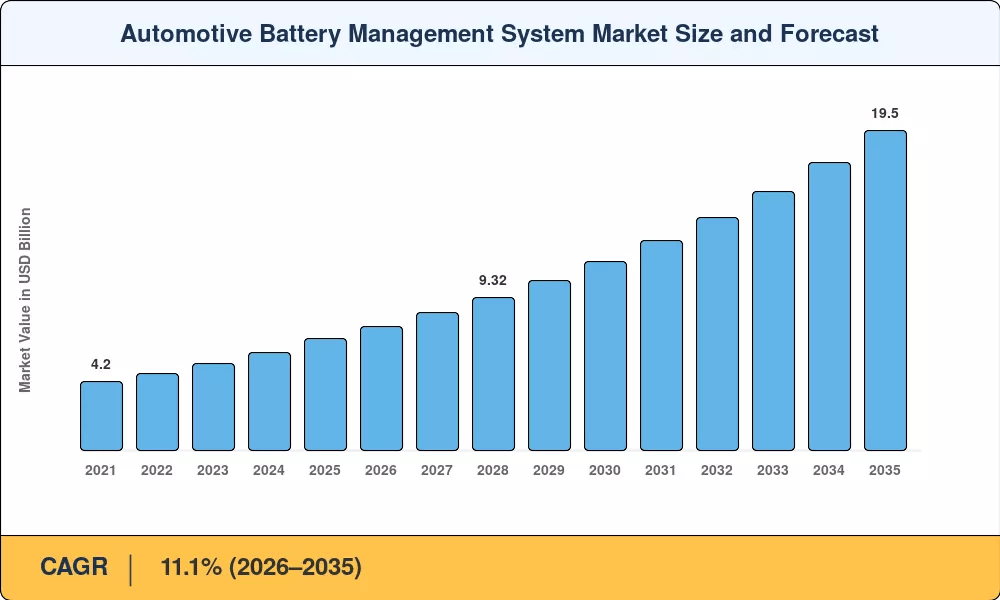
Automotive BMS Market Summary
Asia-Pacific dominates with 42% share, led by Chinese OEM integration of advanced CAN communication protocol stacks
Centralized BMS architecture holds a 48% revenue share of the Automotive Battery Management System Market, favored for cost efficiency in sub-400V packs”
NY, CA, UNITED STATES, July 14, 2026 /EINPresswire.com/ -- An automotive Battery Management System (BMS) is an advanced electronic control unit that serves as the brain of a vehicle's battery pack, monitoring, controlling, and optimizing the performance, safety, and longevity of rechargeable batteries in electric and hybrid vehicles. The BMS performs critical functions including cell voltage and temperature monitoring, state-of-charge and state-of-health estimation, cell balancing, thermal management, overcurrent and overvoltage protection, and communication with other vehicle systems. By ensuring that each individual cell within a battery pack operates within safe parameters and is properly balanced, the BMS maximizes usable battery capacity, extends battery life, prevents dangerous conditions such as thermal runaway, and provides essential data for range estimation and vehicle control. As the electrification of the automotive industry accelerates, the BMS has become an indispensable component of every electric, hybrid, and plug-in hybrid vehicle.— Arti Dhapte
Automotive Battery Management System Market Overview
The Automotive BMS market share is positioned for robust growth through 2035, driven by the accelerating global transition to electric vehicles, the expansion of battery manufacturing capacity, and the increasing sophistication of battery management requirements. The projected valuation of USD 19.50 billion, growing at a CAGR of 11.1%, reflects BMS evolution from a component of electric vehicles to an increasingly central and strategic technology for the automotive industry.
The market is experiencing robust growth driven by several fundamental factors. The accelerating global transition toward electric and hybrid vehicles is the primary growth driver, as every electrified vehicle requires a sophisticated battery management system to ensure safe and reliable battery operation. Government policies mandating zero-emission vehicle adoption, including the European Union's ban on new internal combustion engine vehicles from 2035 and similar initiatives in China, the United States, and other markets, are accelerating EV production and BMS demand. The rapid advancement of battery technology, including the development of higher-energy-density cells and larger battery packs, creates the need for more sophisticated BMS capable of managing complex, multi-cell architectures. The growing emphasis on battery safety, driven by high-profile battery fire incidents, reinforces the importance of robust monitoring and protection functions. Additionally, the expansion of vehicle-to-grid and bidirectional charging capabilities requires advanced BMS with communication and control capabilities beyond traditional applications.
Industry trends indicate a decisive shift toward more intelligent, integrated, and software-defined BMS architectures. The integration of BMS with broader vehicle control systems enables optimized vehicle-level energy management and improved overall efficiency. The adoption of wireless BMS technology, eliminating the complex wiring harnesses between battery cells and the controller, reduces weight, simplifies assembly, and improves reliability. The application of artificial intelligence and machine learning for predictive battery health monitoring and remaining useful life estimation is emerging as a key differentiator. The development of cloud-connected BMS enabling remote monitoring, predictive maintenance, and fleet-level battery optimization is gaining traction in commercial vehicle applications.
Technological developments continue to advance BMS capabilities. The development of higher-precision analog front-end integrated circuits enables more accurate cell voltage and temperature measurement, improving state estimation accuracy. The adoption of advanced algorithms for state-of-charge and state-of-health estimation, incorporating machine learning and Kalman filtering, improves accuracy and adaptability. The development of integrated battery management and power electronics controllers reduces component count and improves system efficiency. The emergence of chip-scale and cell-level monitoring solutions enables more granular battery management and improved safety through earlier fault detection.
Policy and regulatory influence on the Automotive BMS market is significant. Government regulations mandating battery safety and performance standards require BMS to meet specific monitoring and protection requirements. European Union battery regulations impose requirements for battery performance, durability, and traceability throughout the lifecycle, impacting BMS design and data management capabilities. China's stringent safety standards for electric vehicle batteries require BMS with comprehensive monitoring and fault detection capabilities. Government incentives and subsidies for electric vehicles, while not directly requiring specific BMS capabilities, accelerate EV adoption and BMS demand.
The demand outlook for Automotive BMS remains exceptionally strong. As the global electric vehicle market expands from approximately 10% of new vehicle sales toward 50% or higher in major markets over the next decade, demand for BMS will grow correspondingly. The Asia-Pacific region dominates the market, driven by massive EV production in China and the presence of major battery and BMS manufacturers. Europe represents a significant market with stringent regulations and rapid EV adoption, while North America is experiencing accelerating growth driven by the expansion of EV manufacturing and consumer adoption.
📍 Get Free Sample Report for Detailed Market Insights:
https://www.marketresearchfuture.com/sample_request/12310
Automotive Battery Management System Market Segmentation
By Topology
The Automotive BMS market is segmented by topology into Centralized BMS, Distributed BMS, and Modular BMS. Centralized BMS employs a single controller connected to all battery cells through wiring harnesses, representing the traditional approach suitable for smaller battery packs with limited cell count. Distributed BMS employs multiple slave controllers distributed throughout the battery pack, each managing a subset of cells and communicating with a master controller. This topology reduces wiring complexity and improves scalability for larger battery packs. Modular BMS employs standardized, swappable BMS modules that can be combined to scale to any battery pack size, offering advantages in manufacturing flexibility, serviceability, and modularity.
By Vehicle Type
Vehicle type segmentation includes Battery Electric Vehicles, Plug-in Hybrid Electric Vehicles, and Hybrid Electric Vehicles. Battery electric vehicles represent the largest and fastest-growing segment, requiring BMS for large capacity battery packs with dozens to hundreds of cells. Plug-in hybrid electric vehicles require BMS for smaller battery packs with both charge-sustaining and charge-depleting operation modes. Hybrid electric vehicles require BMS for relatively small battery packs used for regenerative braking and power assist applications.
By Application
Application segmentation includes Passenger Vehicles and Commercial Vehicles. Passenger vehicles account for the largest market share, driven by the rapid adoption of electric passenger cars globally. Commercial vehicles, including electric buses, trucks, and delivery vans, represent a fast-growing segment as fleet operators seek to electrify operations to reduce fuel costs, meet sustainability targets, and comply with emissions regulations. Commercial vehicle BMS requirements often include additional features for fleet management, remote monitoring, and battery health prediction.
By Component
Component segmentation covers Hardware and Software. Hardware encompasses analog front-end integrated circuits for cell voltage and temperature measurement, controllers (microcontrollers and microprocessors) for algorithm execution and communication, sensors for current, voltage, and temperature measurement, and associated passive components. Software encompasses state-of-charge and state-of-health estimation algorithms, diagnostic routines, communication protocol stacks, and battery management application software. Software content in BMS is increasing as algorithms become more sophisticated and as cybersecurity and over-the-air update capabilities are integrated.
By Region
Regional segmentation includes North America, Europe, Asia Pacific, South America, and the Middle East and Africa. Asia-Pacific is the largest and fastest-growing regional market, driven by massive EV production in China and the presence of major battery and BMS manufacturers. Europe maintains a substantial share driven by stringent regulations and rapid EV adoption. North America presents significant growth opportunities driven by EV manufacturing expansion and consumer adoption.
🛒 You can buy this market report at:
https://www.marketresearchfuture.com/checkout?currency=one_user-USD&report_id=12310
Automotive Battery Management System Market Competitive Landscape / Key Players
The Automotive BMS market is characterized by the presence of established automotive electronics suppliers, semiconductor companies, and specialized BMS providers. Key companies include NXP Semiconductors, Texas Instruments, Analog Devices, Infineon Technologies, Renesas Electronics, STMicroelectronics, Maxim Integrated (now part of Analog Devices), Panasonic Corporation, Toshiba Corporation, LG Electronics, Robert Bosch GmbH, Continental AG, Denso Corporation, and Lear Corporation.
NXP Semiconductors is a leading provider of automotive BMS semiconductor solutions, offering comprehensive portfolios including analog front-end ICs, battery monitoring devices, and microcontrollers. Texas Instruments provides extensive BMS semiconductor solutions including precision battery monitoring, balancing, and protection devices. Analog Devices is a leader in high-performance analog and mixed-signal solutions for BMS, offering precision measurement and monitoring devices.
Robert Bosch GmbH is a major automotive supplier offering complete BMS solutions including hardware and software, integrated with broader vehicle electrical and electronic systems. Continental AG provides BMS solutions as part of its comprehensive electrification component portfolio. Denso Corporation is a significant BMS supplier with strong presence in the Japanese and Asian markets. LG Electronics provides BMS solutions integrated with its battery manufacturing capabilities, particularly strong in the Korean and global markets.
Strategic developments in the market include the development of wireless BMS technologies, the integration of artificial intelligence for advanced algorithm development, the expansion of BMS software capabilities including predictive health management, and the development of integrated battery and power management solutions. Semiconductor companies are developing increasingly integrated BMS solutions, consolidating multiple functions into single-chip devices for improved performance and reduced cost.
Latest Industry News & Developments
Recent industry developments highlight the ongoing evolution of Automotive BMS technology. The adoption of wireless BMS technology is accelerating, with several automakers announcing development of wireless BMS for next-generation vehicle platforms. Wireless BMS eliminates the complex wiring harnesses traditionally required for cell monitoring, reducing weight by up to 80%, simplifying assembly, and improving reliability. Texas Instruments and Analog Devices have announced wireless BMS solutions leveraging Bluetooth Low Energy and proprietary wireless protocols, enabling modular battery pack design and simplified serviceability.
Artificial intelligence and machine learning are being integrated into BMS for advanced health prediction and optimization. The application of AI for state-of-health estimation, remaining useful life prediction, and thermal management optimization enables more accurate and adaptable battery management. Cloud-connected BMS enabling remote monitoring, predictive maintenance, and fleet optimization is gaining traction, particularly in commercial vehicle and fleet applications where operational efficiency is paramount.
The development of integrated battery and power management systems is advancing, with semiconductor companies developing devices that combine BMS functions with power conversion and motor control capabilities. This integration reduces system component count, improves efficiency, and simplifies vehicle electrical architecture. The adoption of functional safety standards including ISO 26262 for BMS development is becoming standard practice across all major suppliers and automakers, ensuring fail-safe battery management operation.
Automotive Battery Management System Market Challenges & Opportunities
Key restraints facing the Automotive BMS market include the high development cost and complexity of BMS design, requiring specialized expertise in hardware, software, and battery technology. The stringent safety requirements for battery management impose rigorous validation and testing processes, adding development time and cost. The need for BMS to accommodate evolving battery technologies and form factors requires flexible, adaptable hardware and software platforms. The challenge of achieving accurate cell monitoring and balancing across large battery packs with hundreds of cells presents technical challenges for measurement precision and algorithm development. Cybersecurity vulnerabilities in connected BMS require comprehensive security architectures and ongoing monitoring.
Emerging opportunities in the market are substantial and diverse. The accelerating transition to electric vehicles creates significant BMS demand across all vehicle segments and regions. The development of next-generation battery technologies including solid-state batteries, lithium-sulfur batteries, and sodium-ion batteries requires BMS capable of managing these new chemistries, presenting opportunities for early movers. The expansion of vehicle-to-grid and bidirectional charging capabilities requires BMS with advanced communication and control capabilities. The adoption of wireless BMS technology opens opportunities for new form factors, simplified assembly, and improved reliability. The growth of fleet electrification creates opportunities for cloud-connected BMS and predictive battery health solutions.
Future potential lies in the development of cell-level monitoring and control solutions enabling individual cell optimization, the integration of AI for real-time battery optimization, the development of BMS for emerging battery chemistries, and the adoption of wireless charging systems and battery swapping solutions requiring BMS integration. The convergence of BMS with broader vehicle energy management systems creates opportunities for holistic optimization of vehicle energy use and efficiency.
To explore more market insights, visit us at:
https://www.marketresearchfuture.com/reports/automotive-battery-management-system-market-12310
The medium-term growth outlook remains strongly positive, supported by global EV adoption targets, the expansion of BMS functionality, and the growth of battery manufacturing capacity across all regions. Asia-Pacific will continue to lead market expansion, while Europe and North America maintain significant positions through technology leadership and regulatory-driven adoption.
Long-term industry potential extends beyond the current forecast horizon, as the convergence of battery technology advancement, vehicle electrification, and energy management creates new opportunities for BMS innovation. The development of wireless BMS, AI-powered management, and integrated energy solutions will reshape the market landscape. Companies that successfully innovate in semiconductor solutions, BMS software, and integrated vehicle energy management will capture disproportionate value. As vehicles become increasingly electric, connected, and autonomous, the BMS will remain essential to ensuring safe, reliable, and efficient battery operation across the global vehicle fleet.
More Related Reports from MRFR Library:
https://www.marketresearchfuture.com/reports/software-defined-vehicle-market-13918
https://www.marketresearchfuture.com/reports/railway-signaling-system-market-13919
https://www.marketresearchfuture.com/reports/us-automotive-pcb-market-18230
https://www.marketresearchfuture.com/reports/automotive-brake-by-wire-systems-market-21308
https://www.marketresearchfuture.com/reports/india-two-wheeler-market-21400
https://www.marketresearchfuture.com/reports/india-auto-parts-market-21432
https://www.marketresearchfuture.com/reports/india-automotive-wiring-harness-market-21668
https://www.marketresearchfuture.com/reports/racing-simulator-market-21942
https://www.marketresearchfuture.com/reports/automotive-ethernet-market-21944
https://www.marketresearchfuture.com/reports/class-8-truck-market-22479
Larry Wilson
WantStats Research And Media Pvt. Ltd.
+1 855-661-4441
email us here
Visit us on social media:
LinkedIn
Facebook
YouTube
X
Legal Disclaimer:
EIN Presswire provides this news content "as is" without warranty of any kind. We do not accept any responsibility or liability for the accuracy, content, images, videos, licenses, completeness, legality, or reliability of the information contained in this article. If you have any complaints or copyright issues related to this article, kindly contact the author above.
