

Soft adhesive hydrogel improves long-term wearable health monitoring
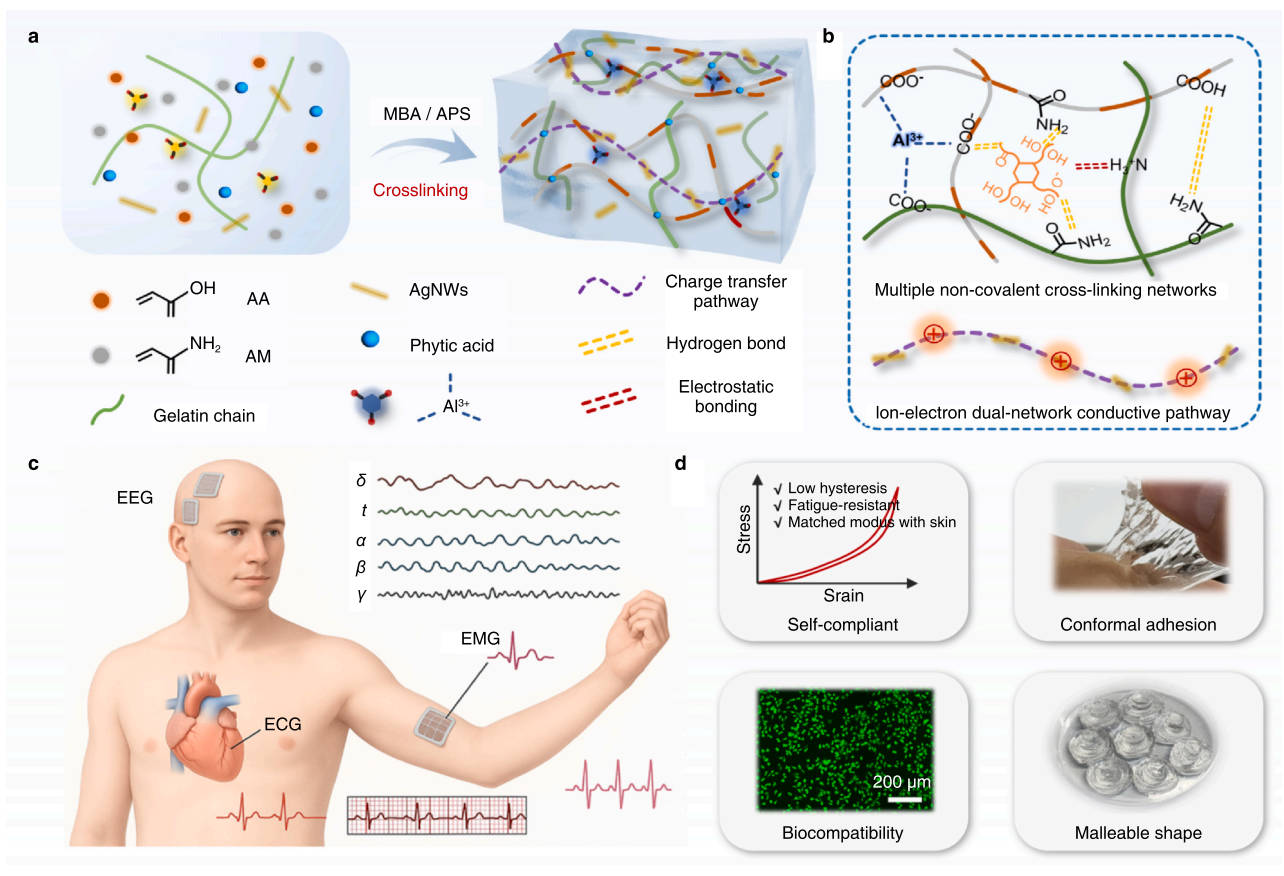
A soft adhesive hydrogel interface for wearable electrophysiological monitoring.
GA, UNITED STATES, July 15, 2026 /EINPresswire.com/ -- Researchers have developed a soft, adhesive hydrogel interface that helps wearable electrodes stay in close contact with skin during long-term electrophysiological monitoring. The hydrogel matches the softness of human skin, resists fatigue and water loss, and enables high-fidelity recording of ECG, EMG and EEG signals, even during movement, sweating and oily skin conditions.
Wearable health devices rely on electrodes that can pick up tiny electrical signals from the body. However, maintaining a stable connection between an electrode and the skin remains difficult. As the skin is soft, uneven and constantly moving, many electrode materials are either too stiff, dry out over time or lose signal quality during daily activity.
In a study published in Wearable Electronics, researchers developed a self-compliant and adhesive hydrogel interface designed to form a soft, stable bridge between wearable electrodes and skin. The hydrogel, called PPGA-Al, combines a flexible polymer network with gelatin, silver nanowires, ions and multiple reversible molecular interactions.
“The challenge is not simply to make an electrode soft,” says senior and co-corresponding author Ting Zhang. “For long-term electrophysiological monitoring, the interface must stay comfortable, adhesive and electrically stable while the wearer moves, sweats or changes skin conditions.”
The team’s design allows the material to be soft and stretchable, while also remaining mechanically robust and electrically stable. “The hydrogel achieved a Young’s modulus of around 30 kPa, close to that of soft skin tissue, and showed a low mechanical energy loss coefficient of 5.06%,” shares Zhang. “It also maintained strong adhesion to biological tissue and supported low-impedance signal transfer through coupled ionic and electronic conductive pathways.”
When integrated with wearable electrodes, the hydrogel enabled high-quality ECG, EMG and EEG recording. “The electrodes achieved a signal-to-noise ratio of around 28 dB and supported 6 h continuous EEG monitoring,” says co-corresponding author Lianhui Li. “They also maintained stable performance during exercise, sweating and oily skin conditions, suggesting potential for more reliable wearable health monitoring in real-world use.”
The new molecular coupling strategy helps solve several problems at once: softness, adhesion, fatigue resistance and signal stability. “We believe this approach can support the development of next-generation epidermal electronics for personalized healthcare,” adds Li.
References
DOI
10.1016/j.wees.2026.02.001
Original Source URL
https://doi.org/10.1016/j.wees.2026.02.001
Funding information
This work was supported by the National Natural Science Foundation for Distinguished Young Scholars of China 62125112, the Strategic Priority Research Program of the Chinese Academy of Science XDB0520301.
Lucy Wang
BioDesign Research
email us here
Legal Disclaimer:
EIN Presswire provides this news content "as is" without warranty of any kind. We do not accept any responsibility or liability for the accuracy, content, images, videos, licenses, completeness, legality, or reliability of the information contained in this article. If you have any complaints or copyright issues related to this article, kindly contact the author above.
